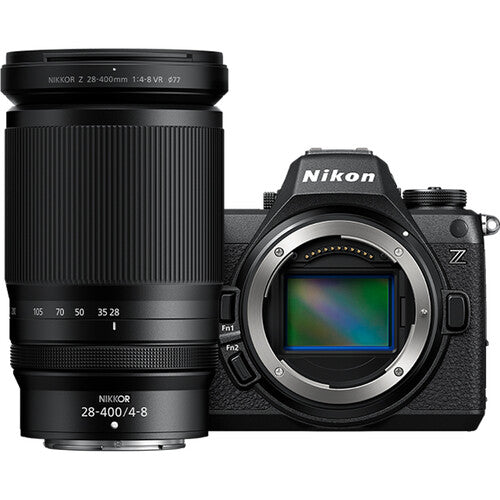
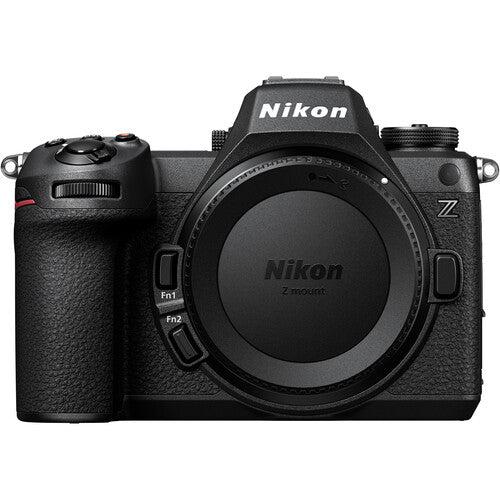
The Nikon Z6 III pairs a 24.5MP partially stacked CMOS sensor with EXPEED 7 processing for demanding photography and video work. Its sensor design speeds up readout, reduces rolling shutter, and improves responsiveness while supporting faster autofocus, higher shooting rates, and a smoother electronic viewfinder image.
EXPEED 7, also used in Nikon’s flagship cameras, is described as approximately 10x faster than its predecessor. That processing power supports rapid autofocus, sustained bursts, a larger buffer, and video capture.
• Shoot up to 20 fps in RAW, 60 fps in full-frame JPEG, or 120 fps in DX-crop JPEG.
• A buffer exceeding 1000 frames supports extended bursts.
• Pre-release capture records action before the shutter button is fully pressed.
• An electronic shutter reaching 1/16,000 sec supports shooting in bright conditions, while autofocus calculations run at up to 120 fps for subject tracking.
Autofocus coverage extends across nearly the entire sensor. Starlight mode allows focusing down to -10 EV, and Backlit AF helps with high-contrast scenes. For moving subjects, the camera offers 3D Tracking and Dynamic-Area AF. Deep-learning subject recognition tracks people, animals, vehicles, and aircraft, while enhanced Eye-Detection AF helps maintain focus on eyes in complex scenes.
- Portrait tools provide several approaches to skin tones and image rendering:
• Portrait mode emphasizes natural skin texture.
• Rich Tone Portrait combines vivid rendering with detail.
• Flat and Deep Tone Monochrome offer additional creative looks.
• Skin softening can be applied to up to three subjects.
• Improved white balance supports accurate skin tones.
Pixel shift combines multiple exposures to produce images up to 96MP. This mode improves resolution, color accuracy, and texture while reducing noise and moiré, making it useful for detailed studio, landscape, and archival photography.
Internal video recording includes 6K60p with full pixel readout, with 6K 60p N-RAW and 6K 30p ProRes RAW options. For slow-motion work, the camera supports 4K up to 120p and Full HD up to 240p. Recording formats include 12-bit N-RAW and ProRes RAW HQ, plus 10-bit ProRes 422 HQ and H.265, providing flexibility for dynamic range and color grading.
A 4000-nit electronic viewfinder provides clear viewing in direct sunlight, with 5.76M-dot resolution and a refresh rate up to 120 fps for smooth composition. The source also lists blackout-free viewing. The 3.2-inch, 170° vari-angle touchscreen supports horizontal and vertical shooting positions, with an interface that adjusts to the camera’s orientation.
The compact, lightweight body is designed for handheld and gimbal use, with weather sealing for difficult environments. In-body stabilization provides up to 8 stops of compensation with compatible lenses. Dual card slots support CFexpress Type B and UHS-II SD media, and an optional battery grip can extend shooting time and improve handling.
- Connectivity supports both on-location and connected workflows:
• Nikon Imaging Cloud enables direct-to-cloud uploads.
• Timecode synchronization supports multi-camera setups.
• Full-size HDMI provides video output.
• Headphone and line-in ports support audio control.
• USB-C handles power, data transfer, and tethering.
• Bluetooth and dual-band Wi-Fi support wireless connections.
The included NIKKOR Z 28-400mm f/4-8 VR spans wide-angle through super-telephoto focal lengths in one lens, covering portraits, travel, sports, and wildlife. Its STM motor provides fast, quiet autofocus, while vibration reduction offers up to 5.5 stops of compensation with Synchro VR support. The lens weighs approximately 1.6 lb.
The zoom’s optical construction uses 21 elements in 15 groups for detailed images, and its nine-blade diaphragm helps create smooth background blur. A zoom lock limits lens creep, a 77mm filter thread accepts common filters, and weather-sealed construction supports outdoor use. At 28mm, the lens focuses as close as 7.9 inches.